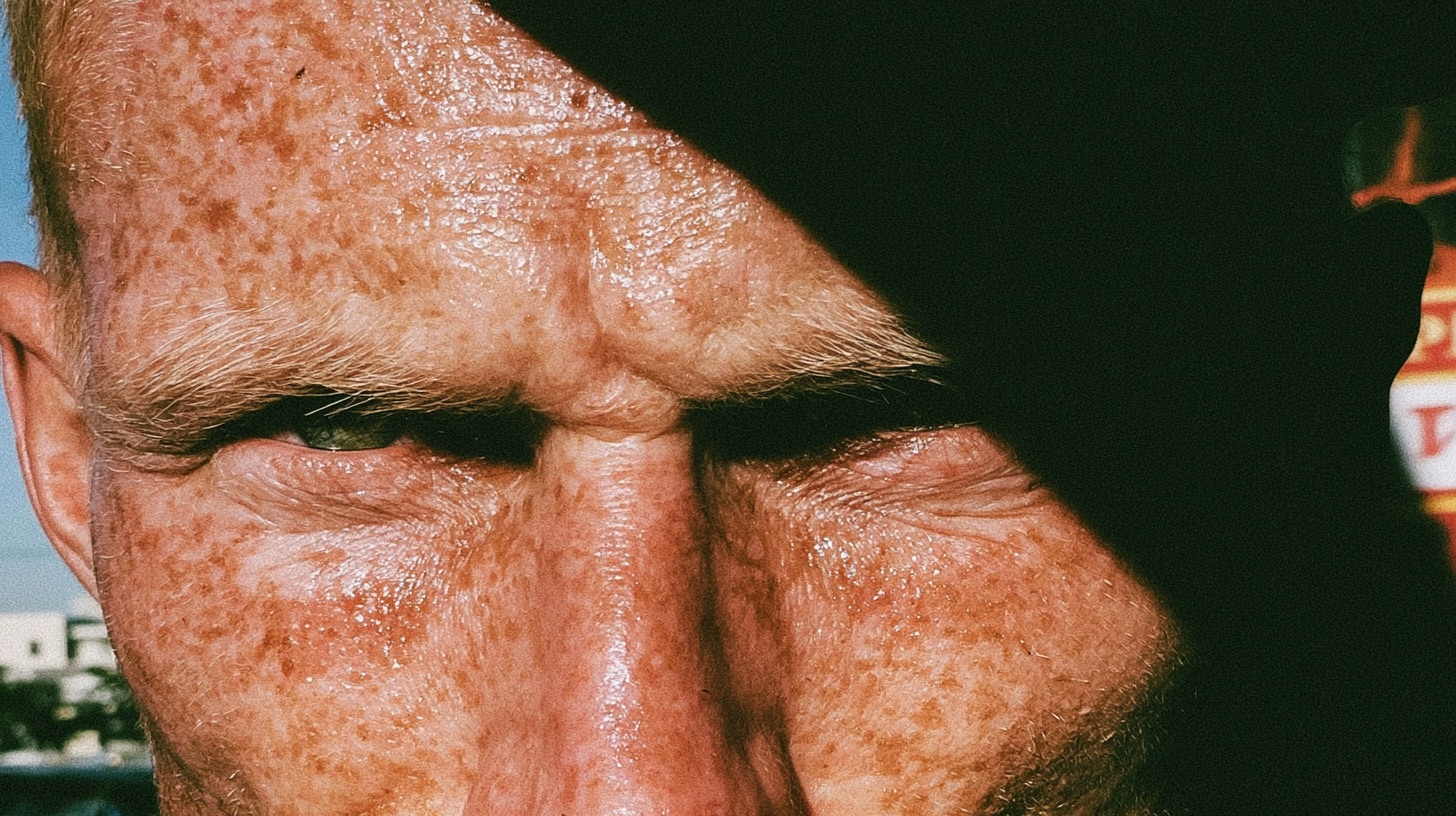

why should I even bother with skincare?
Because male skin starts declining at 23, you're 2.4× more likely to die of melanoma, and 80% of visible aging is preventable with SPF.

Here's the uncomfortable truth: skin condition is the first thing women notice — on a first date, in photos, when you're close enough to see it. They just never say it out loud. You only realize it when the moment is over and you're wondering why they didn't text back. But the SEX appeal is just the beginning. The real argument for skincare is harsher: collagen loss starts at 23, UV damage accounts for 80% of visible aging by 40, and men are dying of melanoma at 2.4 times the rate of women. This isn't vanity. This is geometry.
Of visible aging signs (wrinkles, pigmentation, sagging) are caused by UV exposure, not chronological aging
you're aging faster than you think
Collagen starts breaking down around age 23. Not 45. Not 30. Twenty-three. By age 40, you've lost roughly 10-20% of your structural collagen — the protein that keeps your face from looking like crumpled paper. This isn't something you see overnight. It's a slow erosion. Most men don't notice until it's too late because they're looking at their own face every day. It's like watching grass grow. But a photo from five years ago? Suddenly you see it.
You're not getting older. You're just forgetting what you looked like.
80% of visible aging is sun damage, not time
The sun is the enemy. Not stress. Not sleep. Not whiskey. The sun. Eighty percent of visible facial aging — wrinkles, pigmentation, sagging — is caused by cumulative UV exposure. Not genetics. Not time. The sun. This happens in two ways:
UVB (short-wave ultraviolet radiation) (the burner): You feel it. You see it. Red skin after an afternoon outside. It damages the top layer of your skin. It's the reason sunburn turns into wrinkles and age spots.
UVA (long-wave ultraviolet radiation) (the silent killer): You don't feel it. You don't see it. But it penetrates deep — through clouds, through car windows, through clothing — and destroys collagen and elastin at the dermal level. It's active every day, all year, even in December. UVA is why men who work outdoors age 10-15 years faster than office workers.
Of visible aging signs (wrinkles, pigmentation, sagging) are caused by UV exposure, not chronological aging
men die of melanoma at 2.4× the rate of women
Here's where the science gets dark. Melanoma incidence is higher in men. But mortality is worse. Men don't get diagnosed as early. Men don't self-examine. Men don't use sunscreen — only approximately 12% of men use daily sunscreen versus 29% of women. And biologically, men's skin recovers slower from UV damage and expresses lower levels of antioxidants (glutathione, catalase, superoxide dismutase). The result: men are 2.4 times more likely to die from melanoma than women. This is entirely preventable. Daily SPF50 reduces lifetime UV-induced skin cancer risk by up to 75%. It's the single most effective anti-cancer intervention available. But only 12% of men actually do it.
Men die from melanoma at 2.4 times the rate of women, despite being preventable with consistent daily SPF use

your skin is thicker and oilier (by design)
Male skin isn't just different — it's fundamentally built different. Testosterone drives sebaceous gland activity. Your skin produces up to 73% more sebum than women, especially on the cheeks and forehead. Your epidermis is 10-20% thicker. Your skin pH is lower (more acidic), which means bacterial colonization happens differently. Your skin loses more water through the epidermis (transepidermal water loss is ~40% higher in men). This has two consequences: First, your skin is more prone to oiliness, clogged pores, and irritation from standard moisturizers designed for female skin. Off-the-shelf products sit on top of your thicker skin doing nothing. You need formulations designed around male skin architecture. Second, you can't ignore it. Ignoring male skin leads to visible shine, enlarged pores, and accelerated aging in the oily zones (cheeks, T-zone). A simple daily moisturizer designed for male skin regulates this. Not temporarily. Structurally.
but most men don't care until they lose something
The frustrating truth: men don't start skincare because of collagen loss statistics or melanoma risk data. Men start skincare because they see an old photo of themselves and don't recognize the person. Or they notice someone didn't text back. Or they catch their reflection in a window and think "when did I start looking like a leather wallet?" Skincare isn't about vanity. It's about not waking up in five years wondering what happened.
You're going to age anyway. The question is whether you'll do it on purpose or by accident.
the 30-second solution
The friction for men is routine complexity. You won't do ten steps. You won't do five. You'll do one. One product that replaces four — SPF50 + niacinamide + hyaluronic acid + vitamin E — takes 30 seconds. Applied daily, it solves the three arguments above: it blocks UV (preventing 80% of aging), reduces sebum output, and replaces the moisture your male skin loses. That's the entire argument. That's why skincare matters for men. And that's why it needs to be simple enough to stick.
further reading
For more information from medical authorities: - [BAD — Skin Health Info](https://www.skinhealthinfo.org.uk/) - [Cancer Research UK — Sun safety](https://www.cancerresearchuk.org/about-cancer/causes-of-cancer/sun-uv-and-cancer/sun-safety)
quick answers